Full Stack Service Mapping
See how every application, service and infrastructure component connects, so you can pinpoint impact and root cause in seconds.
Fabrix.ai Full Stack Service Mapping
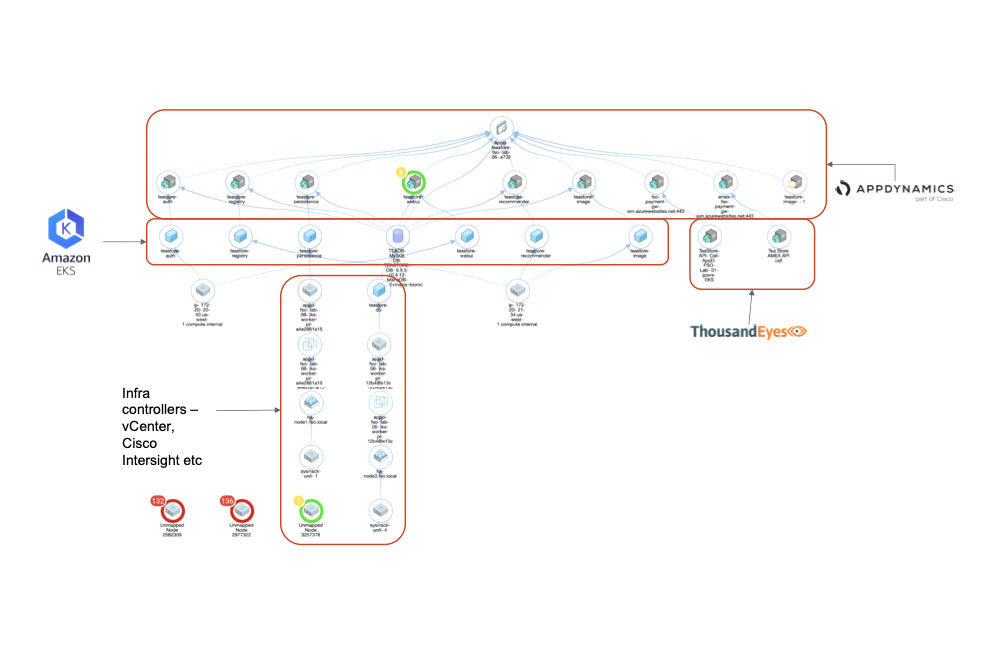
Full-stack service mapping is a core component of the Fabrix.ai AIOps platform. It provides a comprehensive understanding of the relationships between applications, services and underlying infrastructure components, so organizations can understand their IT environment more deeply and optimize operations.
Key Components
Everything needed to discover, visualize and keep your service map current.
-
Automatic Discovery
Fabrix.ai automatically discovers and maps dependencies between services, applications and infrastructure components.
-
Topology Visualization
Visual representations of service relationships make complex systems easier to understand.
-
Dependency Mapping
Identifies dependencies between services, enabling impact analysis and troubleshooting.
-
Dynamic Updates
Continuously updates the service map as infrastructure and applications change.
-
AI-Driven Insights
Leverages AI to analyze service relationships and identify potential issues.
Benefits
What teams gain from a full-stack view of service dependencies.
-
Improved Incident Response
Faster identification of impacted services and root cause analysis.
-
Optimized Resource Utilization
Identify resource bottlenecks and optimize resource allocation.
-
Enhanced Service Availability
Proactive identification of potential service disruptions.
-
Accelerated Application Deployment
Understanding dependencies makes deployments smoother.
-
Cost Optimization
Identify underutilized resources and optimize cloud spending.
How it Works
Fabrix.ai combines data collection, analysis and machine learning to build and maintain the full-stack service map. By correlating data from metrics, logs and traces, it identifies service dependencies and creates a visual representation of the system topology.
Use Cases
-
Incident Management Quickly identify the impact of incidents and prioritize remediation efforts.
-
Capacity Planning Optimize resource allocation based on service dependencies and workload patterns.
-
Application Performance Management Identify performance bottlenecks and optimize application performance.
-
Cloud Migration Assess the impact of cloud migration on applications and services.
-
Security and Compliance Identify security vulnerabilities and compliance risks based on service dependencies.
Challenges in Full Stack Service Mapping
Full-stack service mapping offers significant benefits, but it also presents challenges. Addressing them unlocks its full potential and valuable insights into your IT environment.
-
Data Complexity and Volume
- Diverse data sources: Gathering data from various systems and applications can be complex.
- Data quality issues: Ensuring data accuracy and consistency is crucial for accurate mapping.
- Data volume: Handling large volumes of data efficiently is essential.
-
Dynamic Environments
- Constant changes: IT environments constantly evolve, requiring continuous updates to service maps.
- Real-time updates: Keeping service maps accurate and up to date in real time is challenging.
- Dependency changes: Identifying and tracking changes in service dependencies is complex.
-
Complexity of Modern Applications
- Microservices architecture: Mapping dependencies in microservice environments can be intricate.
- Cloud-native applications: The dynamic, ephemeral nature of cloud resources adds complexity.
- Containerized environments: Tracking dependencies in containerized workloads is challenging.
-
Tool Limitations
- Data integration: Integrating data from various sources can be complex and time-consuming.
- Visualization capabilities: Effectively visualizing complex service relationships can be difficult.
- Automation: Automating the mapping process is challenging in dynamic environments.
Overcoming Challenges in
Full Stack Service Mapping
Strategies and best practices that, combined with the right technologies, help organizations overcome these challenges and gain valuable insights into their IT environments.
-
Data Management and Quality
- Centralized data repository: Establish a single source of truth for service-related data.
- Data cleansing and standardization: Ensure data accuracy and consistency.
- Data enrichment: Add context to data for improved analysis.
-
Automation and AI
- Automated discovery: Use AI-powered tools to automatically discover and map services.
- Machine learning: Employ ML algorithms to identify dependencies and anomalies.
- Continuous updates: Automatically update service maps as the environment changes.
-
Visualization and Collaboration
- Interactive visualizations: Use visual tools to represent complex service relationships.
- Collaboration platforms: Enable teams to collaborate on service map development and maintenance.
- Role-based access: Control access to service map information based on user roles.
-
Change Management
- Impact assessment: Evaluate the impact of changes on services and dependencies.
- Configuration management: Integrate service mapping with configuration management databases (CMDBs).
- Version control: Keep historical versions of service maps for auditing and rollback.
Specific Technologies & Tools
-
Data management platforms
Tools like Fabrix.ai RDAF help manage and enrich data for service mapping.
-
Graph databases
Technologies like Neo4j efficiently store and query complex service relationships.
-
AI and machine learning platforms
Platforms like TensorFlow or PyTorch for building AI models.
-
Visualization tools
Tools like Grafana or Tableau for creating interactive service maps.