This event has expired
Fabrix.ai at 
Multi-Vendor, Governed VibeOps:
Splunk + Fabrix.ai, Powered by Argos SLMs
Splunk Sees It, Argos Reason Over It,
Governed VibeOps Acts on It.
Schedule a Meeting
The Shift
Beyond Dashboards:
Multi-Vendor Vibe Applications
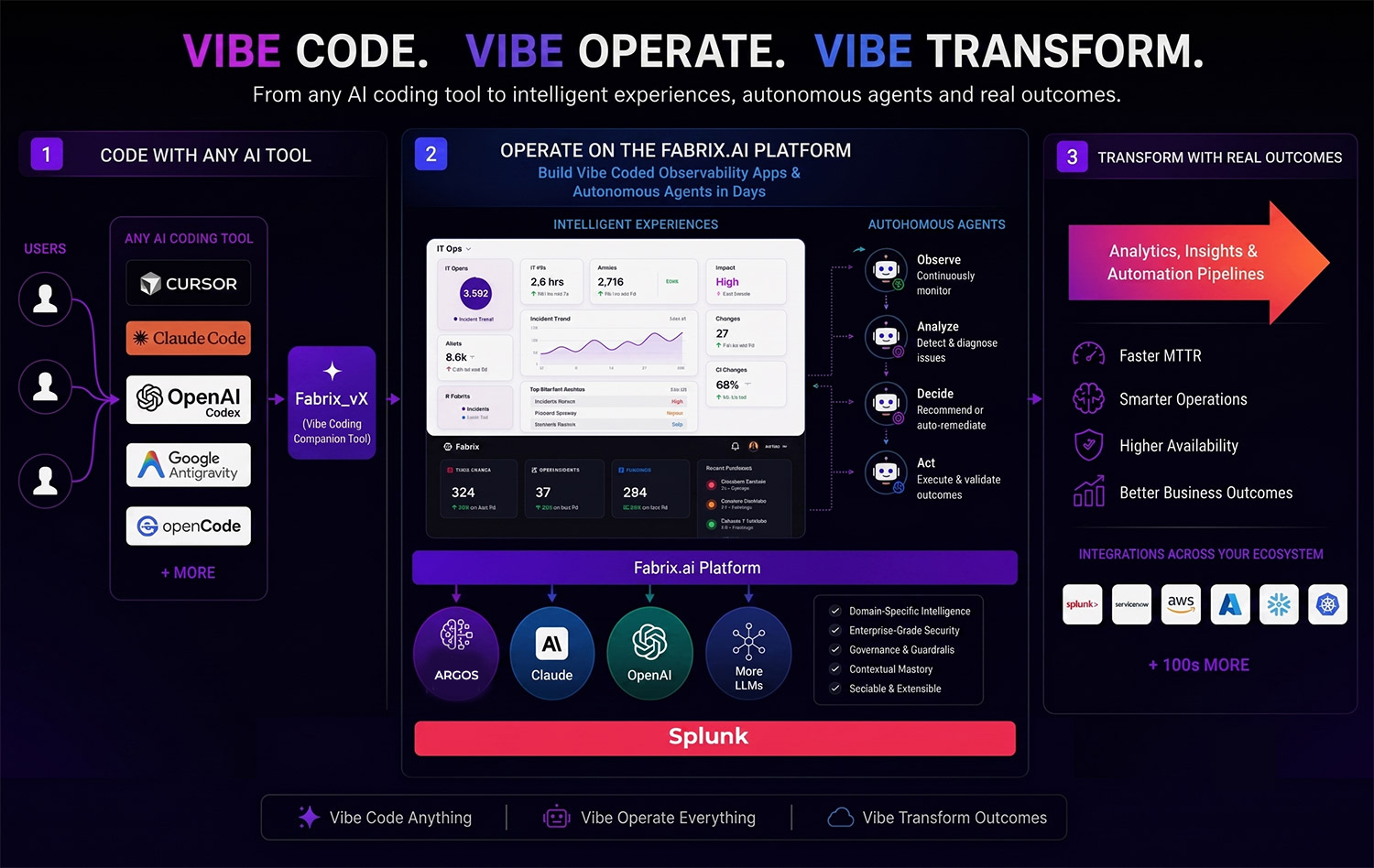
Building vibe-coded apps rapidly and securely with Fabrix
Use the tools you already love - Cursor, Codex, Claude Code, or AntiGravity. Simply add the Fabrix_VX configuration to your AI development tool of choice.
Fabrix vX simply connects these tools to the Fabrix Argos VX specialized models and the Fabrix Agentic Platform, enabling teams to rapidly build:
- Interactive operational applications
- Live dashboards
- Autonomous agents
- Agentic workflows
- End-to-end automation pipelines
That’s the shift
- From UX to vX.
- From DevOps to VibeOps.
- From software delivery to outcome delivery.
These applications continuously evolve with the business instead of waiting months for vendor releases.

Shailesh Manjrekar
Chief Marketing Officer, AI Strategy
Fabrix.ai
Multi-Vendor, Governed VibeOps: Splunk + Fabrix.ai, Powered by Argos SLMs
Most enterprises don't have an agent problem — they have a federation problem. Traditional AIOps vendors are stacking siloed agentic layers on top of siloed data sources, which only moves the swivel-chair from humans to bots. Key Learnings - 1) Federation vs. orchestration vs. dashboards, 2) The four real barriers to a unified control plane, 3) The MTTR → MTTI → MTTP ladder, 4) What "ontology, not CMDB" means in practice
What you will learn
How Fabrix brings vibe-coded speed to enterprise IT operations
DevOps promised to turn ideas into production faster. VibeOps finally delivers on that promise - letting enterprises build, deploy, operate, and evolve AI-powered applications and agents in days, not months.
What Is VibeOps?
VibeOps is an emerging AI-driven approach to operations and infrastructure that extends “vibe coding” to cloud, network, and system management - applying Andrej Karpathy’s vibe-coding philosophy to observability, infrastructure, ops, and continuous deployment.
Just as DevOps revolutionized software delivery, VibeOps revolutionizes enterprise AI delivery.
What Is vX?
vX - Vibe-Coded User Experience. UX is defined from the vendor’s perspective. vX is the user experience defined from the user’s own perspective - a curated experience, not a prescribed one.
Fabrix’s vX methodology
Lets developers and operators rapidly build agentic applications, backed by the tools, platform, and SLM needed to build a vibe-coded experience at speed.
What is Fabrix’s Argos Family of SLM’s
Argos is Fabrix’s family of specialized small language models (SLMs), AI purpose-built for enterprise IT operations. Instead of one giant, general-purpose model trying to do everything, Argos is a family of models, each engineered around one discipline: understanding operational events, assessing vulnerability exposure, or building agentic apps and dashboards. Each model is tuned to think like an expert in its lane, and sized for the job it actually has to do, not the biggest job imaginable.
Move from siloed observability to unified, agentic, autonomous operations.
Build a unified ontology through agentic data federation.
Manage token economics across multi-agent orchestration.
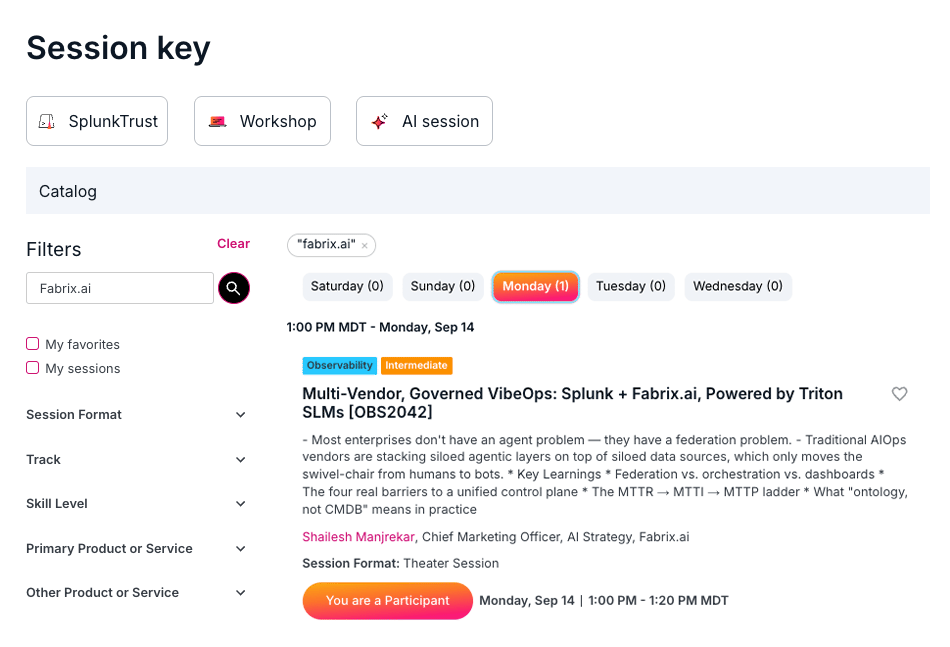
Same vibe-coded app.
A radically different foundation.
Cursor, Claude Code, Codex, Antigravity - they can all build the app. What happens after deploy is where Fabrix is different.
Beyond Governance & Grounding
Fabrix delivers what neither AI app builders
nor standalone coding assistants can:
From signals to outcomes
Most enterprises do not have an agent problem. Fabrix.ai creates a vendor-neutral operating layer around the tools you already own, with Splunk as the place where service health, context, decisions, and approved actions come together.
Data Enrichment for Splunk
Clean, transform, enrich, and route multi-source operational data before it reaches Splunk.
Federate
Bring live context from observability, infrastructure, network, cloud, ITSM, and security systems into a common operational fabric without forcing every source into another silo.
Orchestrate
Coordinate specialized agents, tools, workflows, and approvals across vendors so every step contributes to a shared operational goal.
Reason
Use an enterprise ontology and dependency-aware context to understand services, entities, topology, impact, and likely root cause, not just isolated alerts.
Act
Turn recommendations into controlled remediation with guardrails, explainability, role-based access, and human approval where the business requires it.