Leading Global System Integrator Transforms IT Operations with Agentic AIOps
A global systems integrator unified signals across a large hybrid, multi-cloud estate - then put AI Agents to work on them, moving from reactive firefighting to automated, autonomous operations.
Highlights
- Significant reduction in alert noise and ticket volume
- Faster MTTI / MTTR with AI-driven root cause analysis
- Reduced major outages and outage duration
- Meaningful cloud run-cost optimization
- Faster ROI with a short payback period
About the Customer
The client is a leading Global Systems Integrator operating large-scale hybrid and multi-cloud environments. Its internal IT and SRE teams manage thousands of applications and infrastructure assets across global data centers and cloud platforms.
As scale increased, operations became fragmented across multiple tools with no service-centric view. The integrator needed Agentic AIOps to unify signals across silos, automate incident response, optimize cloud spend, and move from reactive operations to autonomous, AI-driven ones.
Fragmented Operations, Longer MTTR
Operations suffered from siloed visibility, manual incident response and swivel-chair workflows across tools - all of which drove MTTR up. Retired assets continued to generate noise and cost, alert deduplication was ineffective, and cloud spend grew because of resource sprawl and unclear optimization paths.
CMDB lifecycle data was incomplete, which in turn affected reliability and operational efficiency across the estate.
What They Needed
The organization needed to improve service reliability, reduce operational overhead and control cloud spend - while scaling operations without adding headcount. That required a platform able to unify operations, automate decisions, and support teams across roles as they moved toward proactive, AI-driven operations.
Business objectives
- Enable proactive IT management
- Reduce alert fatigue
- Reduce manual effort
- Improve system availability
- Increase IT agility and scalability
Technical needs
- Flexible platform to expand use cases
- Customizable AI Agents for different workflows
- Easy integration with existing systems
- Tailored experiences for Ops users
- Intuitive platform with a low learning curve
An AIOps Foundation, Then Agents That Act on It
The integrator deployed the Fabrix.ai Agentic AIOps Platform on-prem to unify telemetry for topology mapping, cross-domain correlation, noise reduction and predictive insights.
On top of that foundation, AI Agents operationalized the insights into action - RCA Agents accelerating root cause analysis, Remediation Agents automating response, Capacity Planning Agents forecasting demand, Cloud Cost Optimization Agents driving FinOps actions, and AI summaries and assignment prediction reducing manual triage. This AIOps-to-Agents handoff is what moved operations from insight to action.
Fabrix.ai changed how we run ops. AIOps brought our signals together, and the AI Agents actually acted on them - faster RCA, automated fixes, and real cost optimization. We moved from dashboards to action.
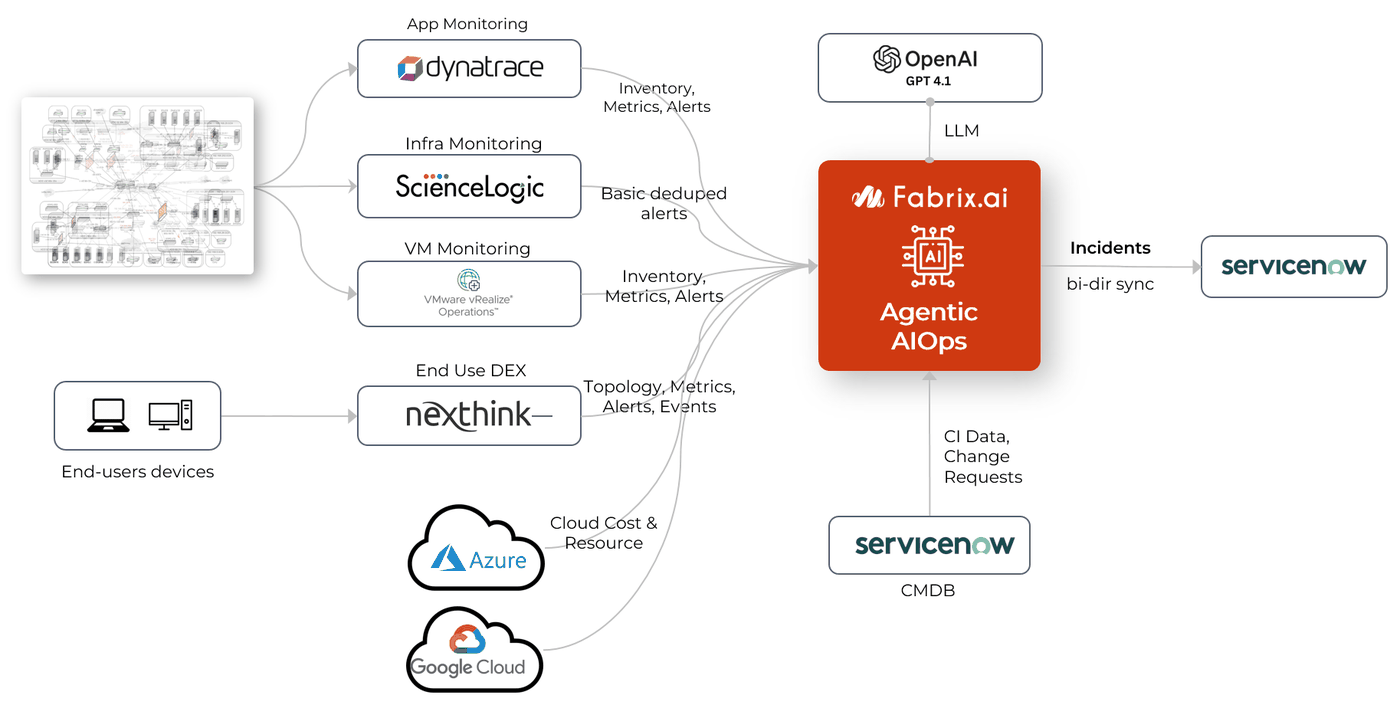
Sources, Agents and Use Cases
Data sources & integrations
- Dynatrace - application monitoring
- ScienceLogic - infrastructure monitoring
- VMware vCenter / vROps - VM monitoring
- Nexthink - digital employee experience
- ServiceNow - CMDB, incidents, change
- Microsoft Azure and Google Cloud Platform
- Customer-provided OpenAI GPT-4.1
Key agents delivered
- RCA & Remediation Agent
- Incident Assignment Agent
- Change Request Insights Agent
- Capacity Insights Agent
- VM Cost Insights Agent
- Cloud Cost Optimization Agent
- Network Config Compliance Agent
- Asset Lifecycle Insights / SACM Agent
- Linux Compliance Agent
- Dynatrace Insights Agent
- AI Observability Agent
- AIOps Reporting Agent
Use cases delivered
- Event correlation & noise reduction
- Predictive insights & anomaly detection
- Topology ingestion & relationship mapping
- Root cause analysis acceleration
- Automated remediation & self-healing
- Capacity optimization insights
- Incident summarization & assignment prediction
- VM and cloud cost optimization across Azure & GCP
Quantified Benefits
Measured against industry benchmarks for the same KPIs.
| KPI | Result | Value ($) | Industry benchmark |
|---|---|---|---|
| Ticket volume reduction | 70%+ | $3.59M | 44% |
| MTTR (monitoring platform) | 60%+ | $1.08M | 35% |
| Overall MTTR reduction | 45%+ | - | 35% |
| MTTA (assignment) | 50% | - | 35% |
| Major outage volume reduction | 70%+ | $1.5M | 40% |
| Major outage duration reduction | 55%+ | $0.5M | 40% |
| Cloud infra run-cost optimization | Up to 55% | - | 50% |
| Payback period | 6 months | - | ~7 months |
In Short
- Fabrix.ai unified signals from Dynatrace, ScienceLogic, vROps, Nexthink, ServiceNow, Azure and GCP into one service-centric view of a large hybrid, multi-cloud estate.
- AI Agents acted on that foundation - RCA, remediation, incident assignment, capacity planning and cloud cost optimization - rather than stopping at dashboards.
- Ticket volume fell by more than 70% and overall MTTR by more than 45%, against industry benchmarks of 44% and 35%.
- Cloud infrastructure run-cost optimization reached up to 55%, and the programme paid back in six months.