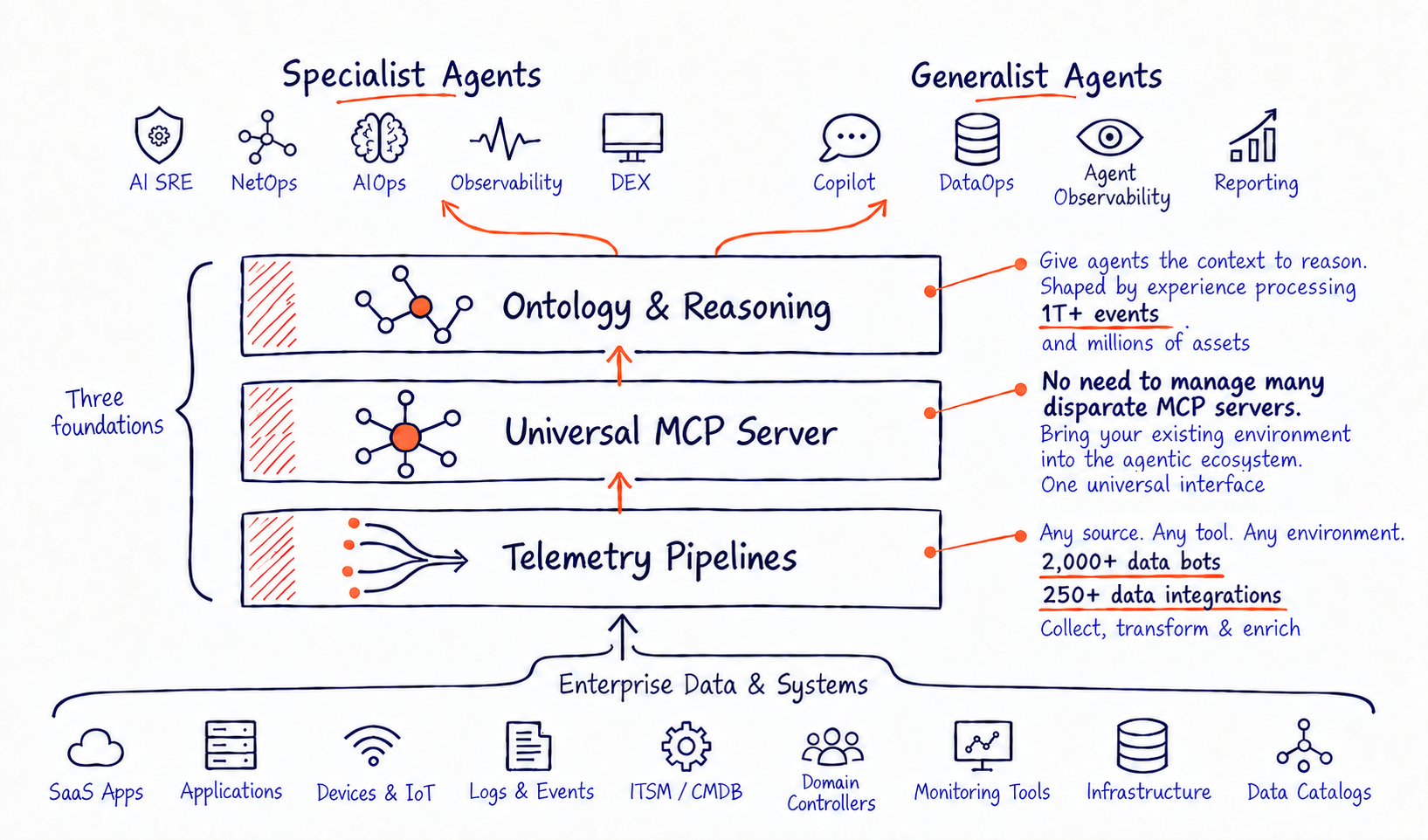
Essential Architecture for
Specialist & Generalist AI Agents
Three foundational building blocks connect enterprise data and systems
to agents that can reason, access and act.
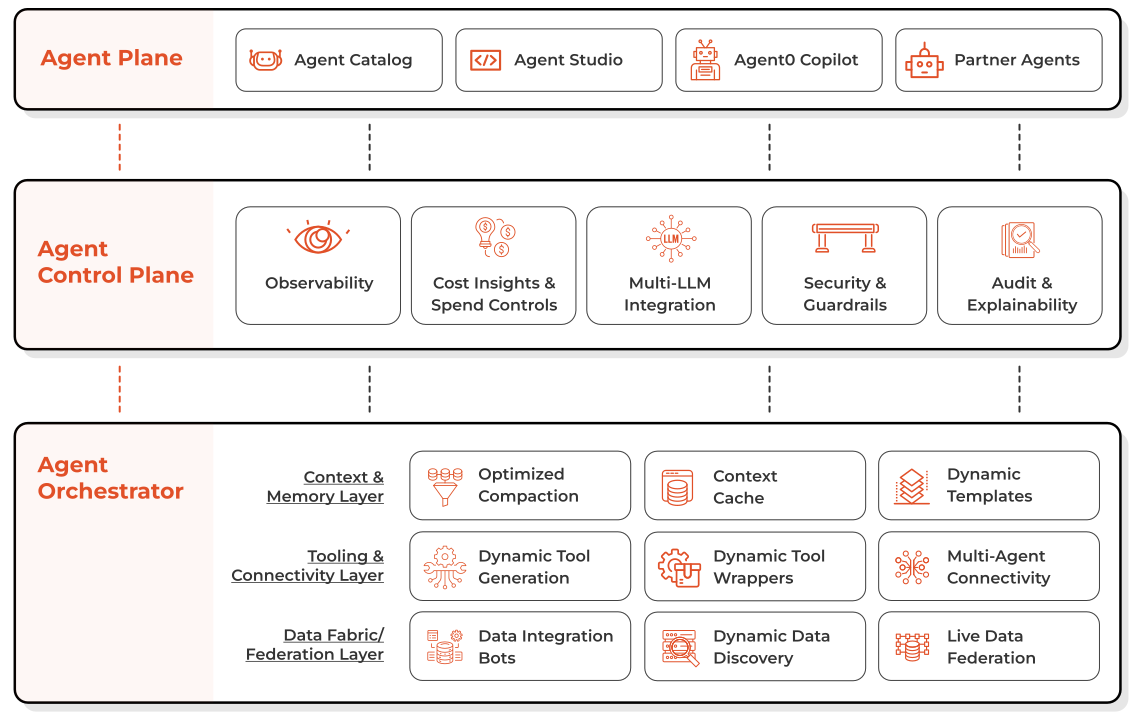
Double-click: inside the agentic layer
Build, Operate and Observe Production Agents
One runtime to create agents, connect your systems, ground them in your data, govern every run and verify every interaction. Pre-built agents and solutions are what you deploy on top — not what the platform is.
The Three Foundations of
Production-Ready AI Agents
The double-click: inside the FabrixONE core, three products make agents production-ready - grounded in context, orchestrated into work, and governed on every run.

Agent Control Plane
Every AI action traced, governed, and explainable
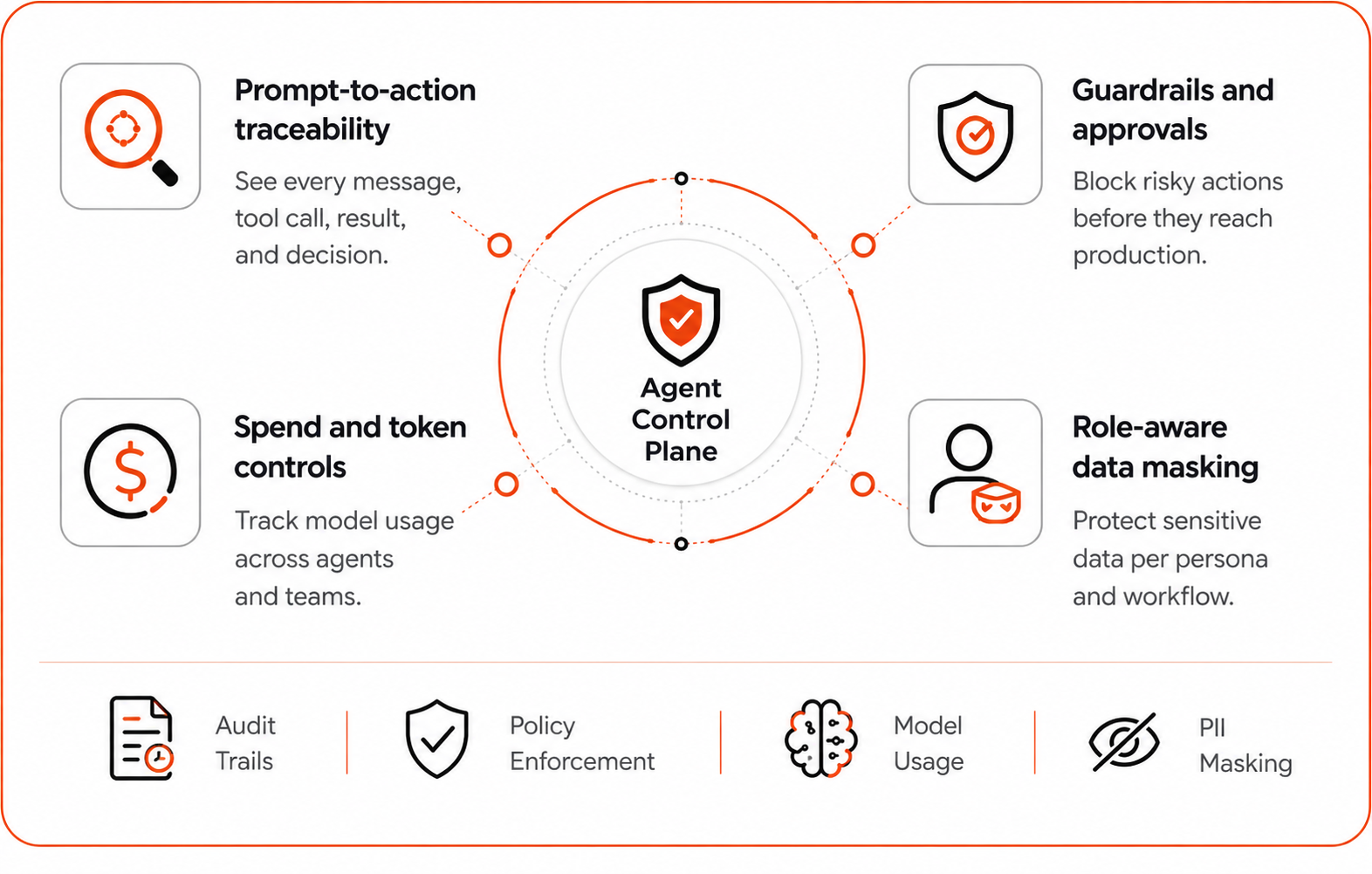
A shared control layer for observability, approvals, policy enforcement, audit trails, PII masking, model usage, token spend, and agent behavior across teams, tools, and LLM providers.
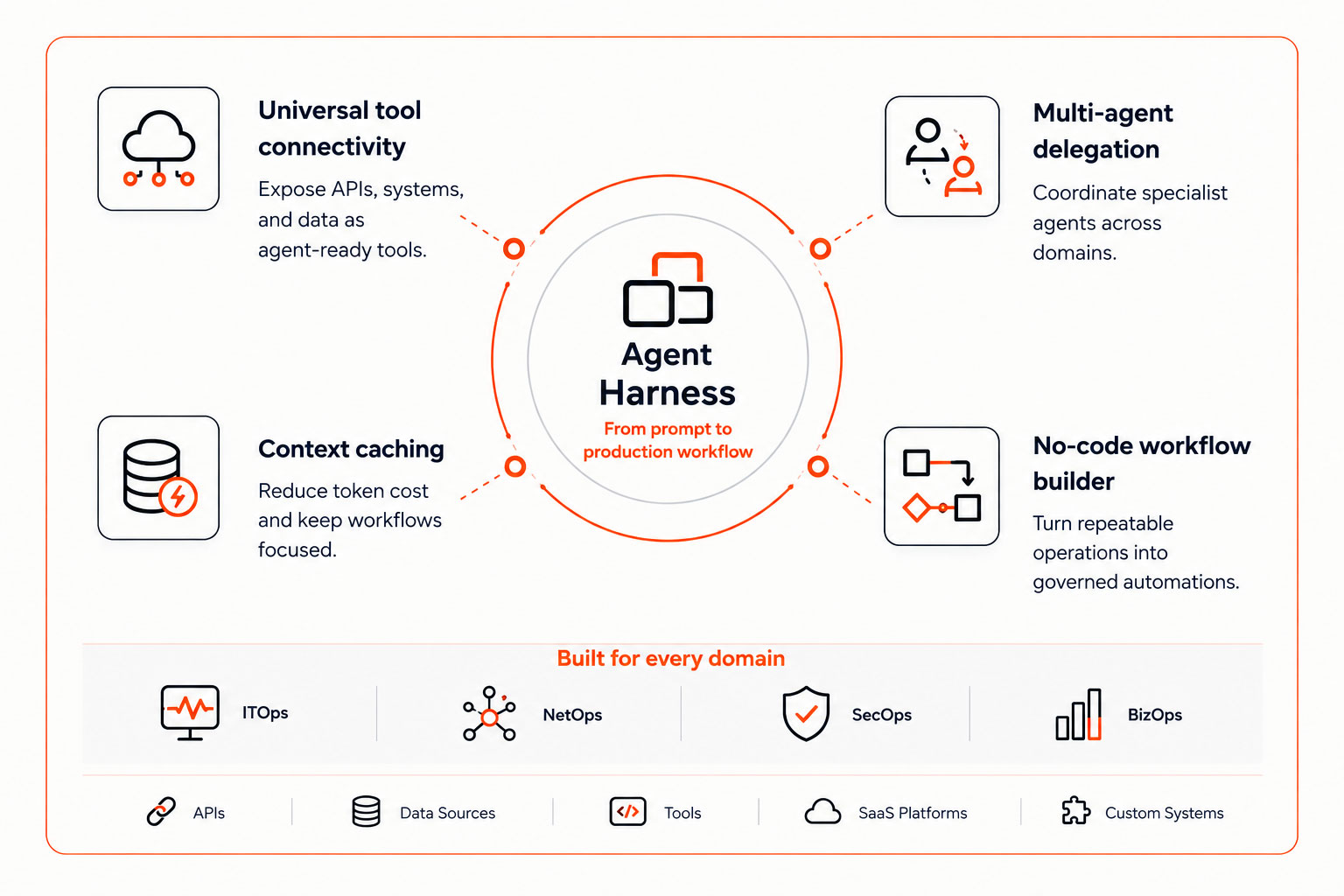
Agent Harness
From prompt to production workflow
A no-code orchestration layer that connects agents, tools, APIs, data sources, and workflows - enabling single-agent execution or multi-agent handoffs across ITOps, NetOps, SecOps, and BizOps.
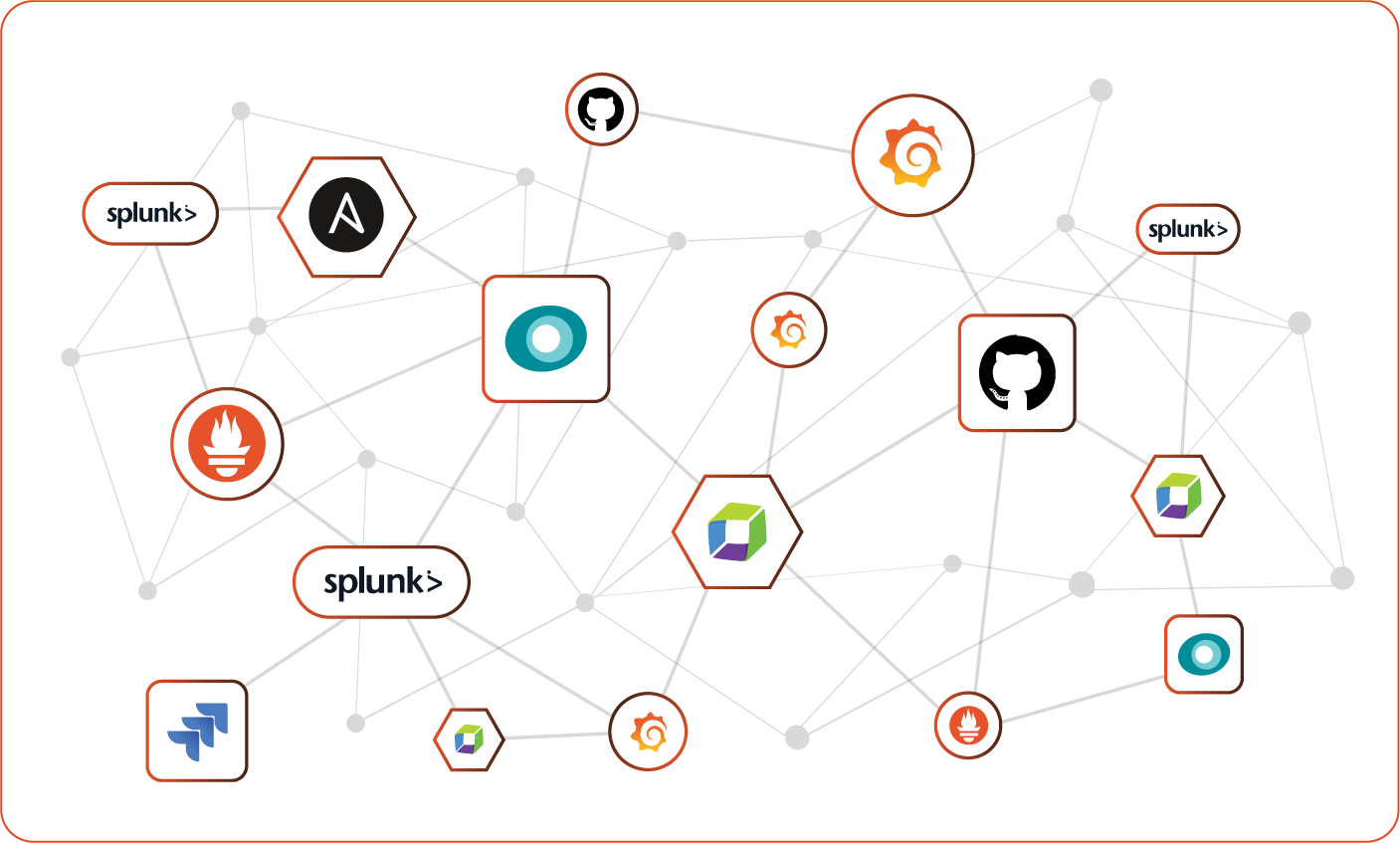
Ontology & Reasoning
Always-on enterprise context for every agent
A continuously updated enterprise knowledge graph that grounds every agent in real assets, topology, dependencies, events, services, owners, and business context - not stale snapshots or disconnected alerts.
AgentOps Capabilities
Enterprise Grade Capabilities from build to observe - guardrailed,
auditable agents engineered for enterprise scale.
Copilot
Prototype an agent in conversation. Test tool calls, iterate, then package it for production.
Agent Studio
Effortlessly create your own agent with a prompt or start from a template. Customize & iterate or activate right away.
Multi LLM Choice
Support featured LLMs. On-Prem or Cloud. Seamless Integration. Nvidia Ready
Smart Context Mgmt.
Provides context caching for optimal token usage, allows LLMs to work with very large datasets.
Security & Guardrails
Enforce safety, policy, and intent checks on every run-blocking non-compliant prompts and destructive actions-via seamless integrations with dedicated models and providers
Data Protection
Per-persona data masking for Agentic AI. Sensitive fields are masked before prompts reach the LLM and optionally unmasked client-side when rendering results-end-to-end auditable
MCP Tools
Allow LLM access to your data and tools using MCP protocol. Built-in MCP server. Dynamically add new MCP tools with no-code.
Grounding & RAG
Ground agents in your documents, knowledge bases and live topology - answers stay anchored to your environment.
Prompt Templates
Set of instructions for LLMs to process data and results tailored to your use case. Modifiable from UI. No code.
AI Personas
RBAC‑like scoping presents only persona‑relevant MCP tools and data to LLM, improving accuracy and governance.
Prompt to Agent
From prompt to production agent-prototype in Copilot, iterate, then simply ask to create Agent with persona, tools, prompts, and workflow auto-packaged
Orchestration
No-code, drag-and-drop approach to easily build and operate agentic workflows. Built-in task library.
Human-in-the-Loop
Approval gates on high-stakes actions, with full context in your workflow and a complete audit trail.
Agent Triggers
Cron-style schedules and event triggers - ticket created, threshold breached, deployment finished. Every run logged.
The Access Layer
Universal MCP Server
Agents don’t struggle with reasoning - they struggle with access.
Fabrix dynamically wraps REST, SSH/CLI, message systems, and vendor MCP tools into one seamless agent interface, unifying connectivity, authorization, and data mapping into a single cohesive access layer.
Agentic Data Federation
Agents go to the data.
The data stays put.
Enterprise telemetry is fragmented and centralising it no longer scales. Fabrix federates insight in real time - with zero copy.
Agent Control Plane
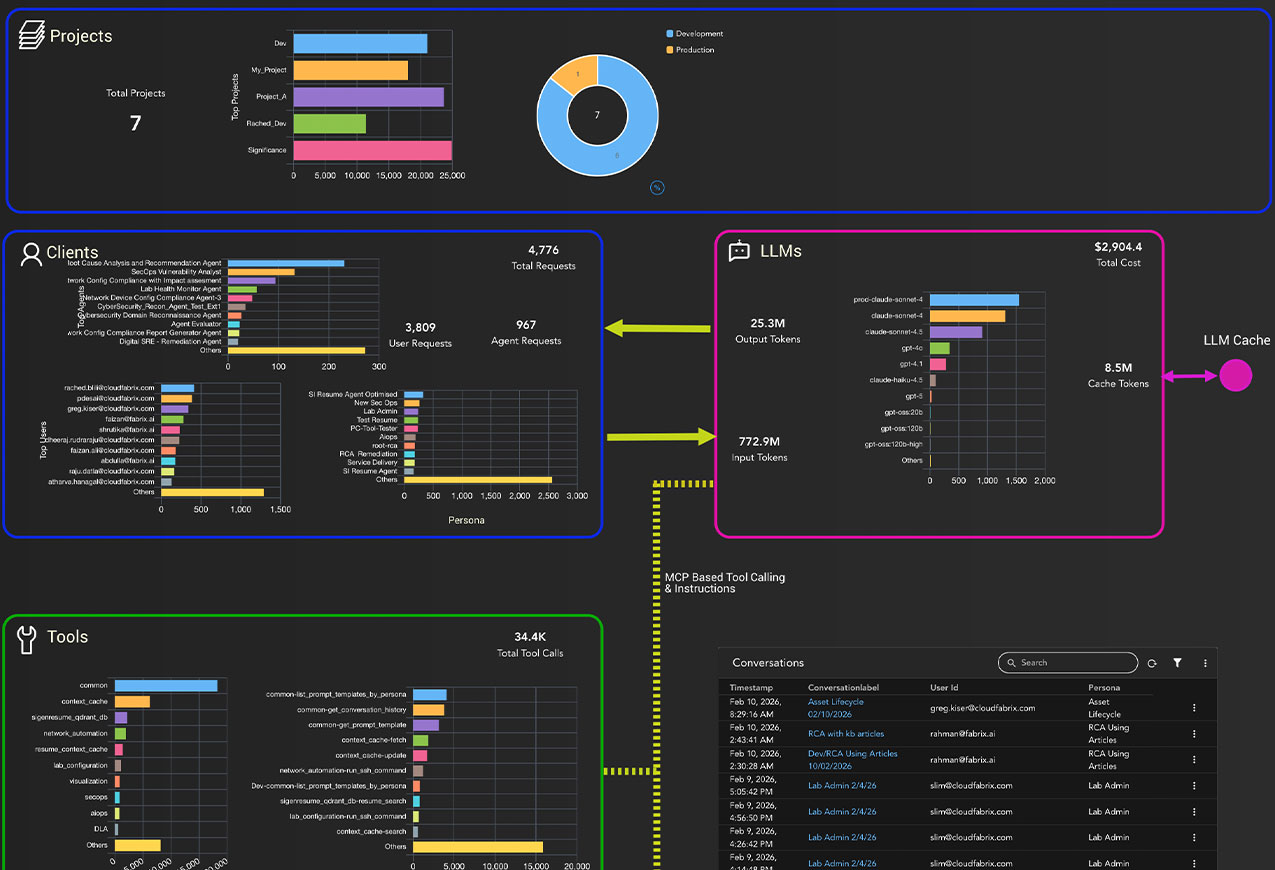
Every AI interaction - traced, explained, and under control.
One dashboard for AI across your entire business - teams, apps, and providers. See usage, outcomes, and spend at a glance, then drill into any team, agent, or run.
- Snapshot by department / team / app / provider
- Cost, requests, and tokens at a glance
- Leaderboards: top users, agents, personas
- Provider & model mix - share and trends
- One-click drilldowns: org → team → run
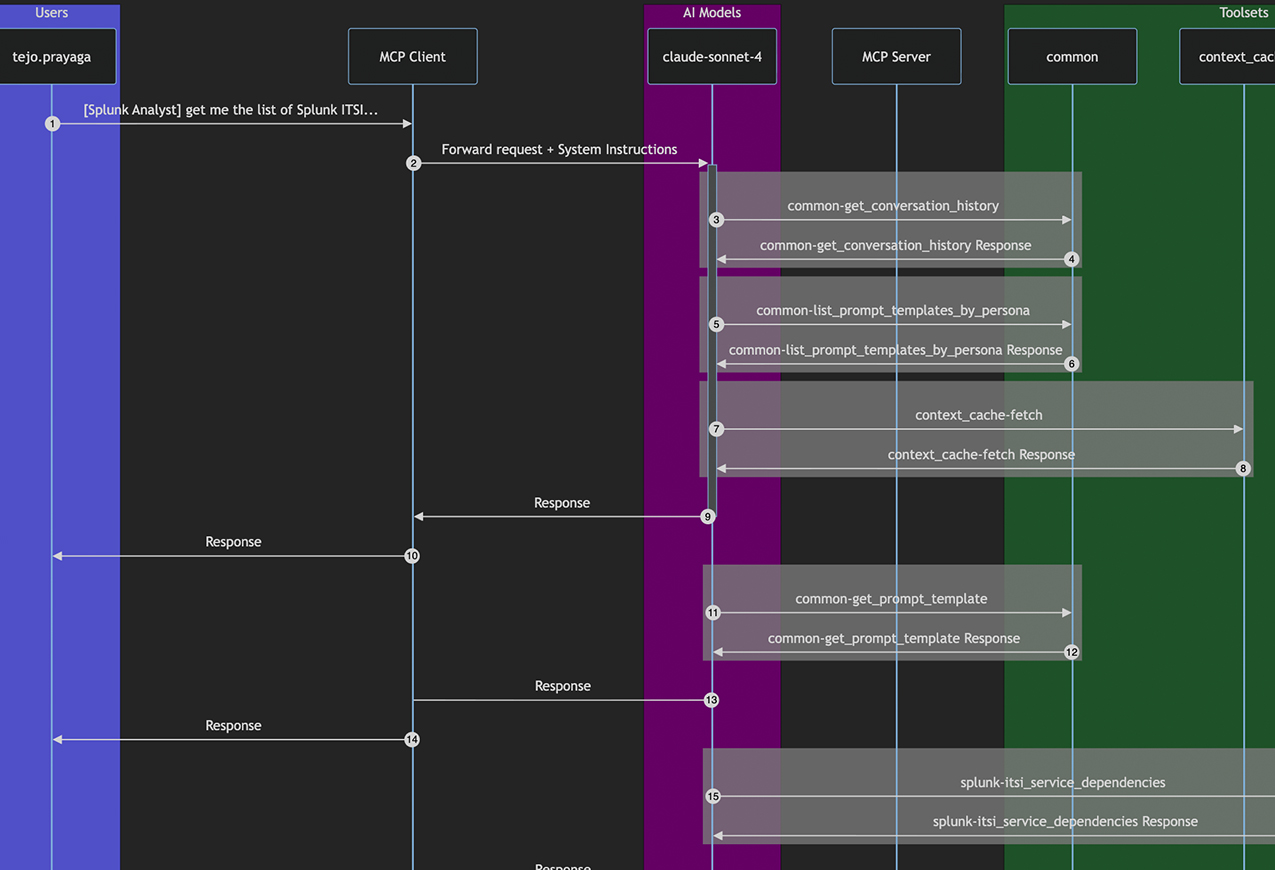
Every agent run leaves a complete trace - from the first prompt to the final action. See every tool call, every model invocation, every branch and retry, with full payload visibility and PII masking built in.
- Persona → Prompt → Context → Tools → LLM → Result
- Payload view with redaction & PII masking
- Retries, fallbacks, branching and loops
- Latency breakdown per step - exportable traces
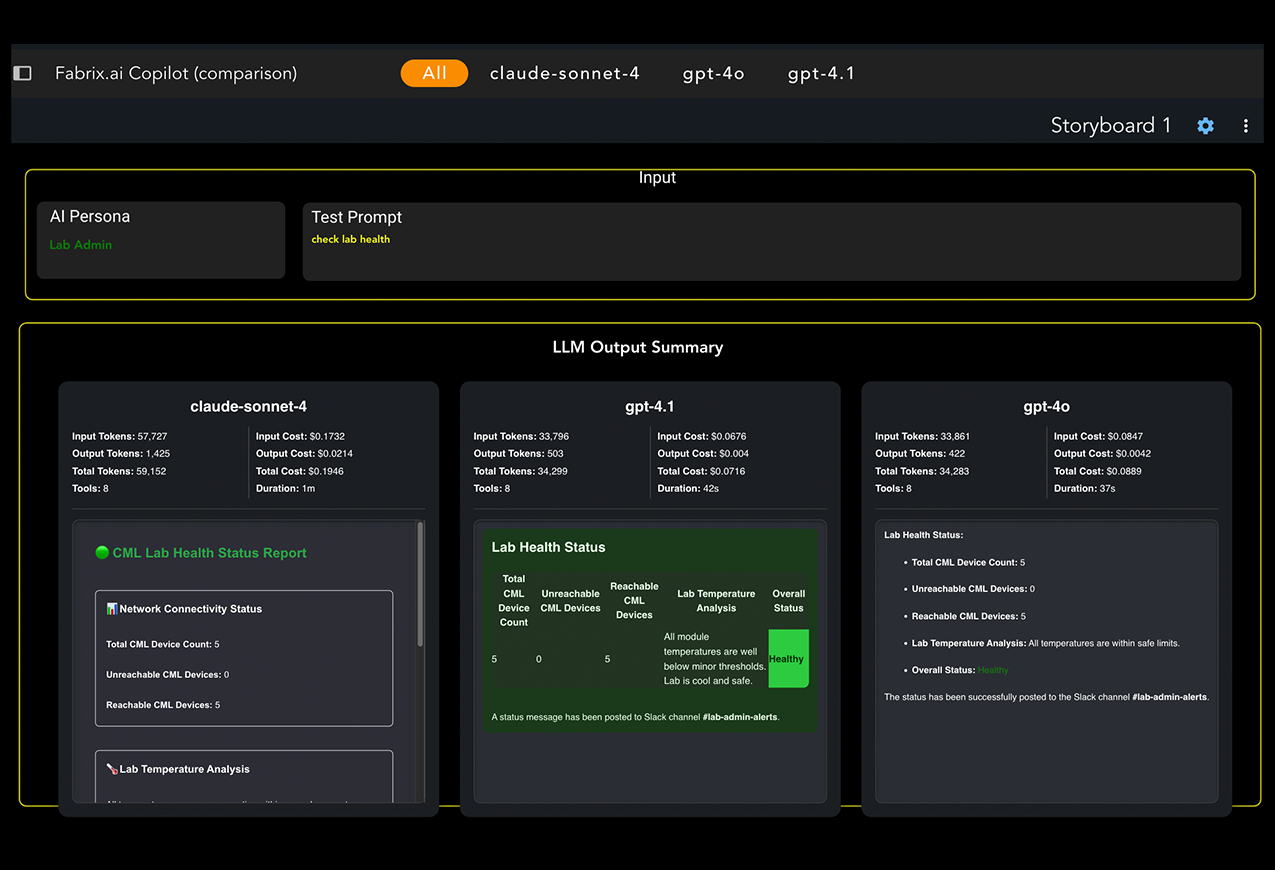
Don't guess which model is best for your use case - prove it. Run side-by-side model evaluations on your own data and rank quality, cost, and reliability before you deploy.
- A/B/C tests per use case
- Metrics: accuracy, factuality, coherence, safety
- Ops: tool calls, latency, tokens, $/result
- Human ratings + ground-truth scoring
- Leaderboards, recommendations, audit reports
- Drift detection: daily analysis catches degradation early
- Continuous improvement: prescriptive fixes backed by real failures
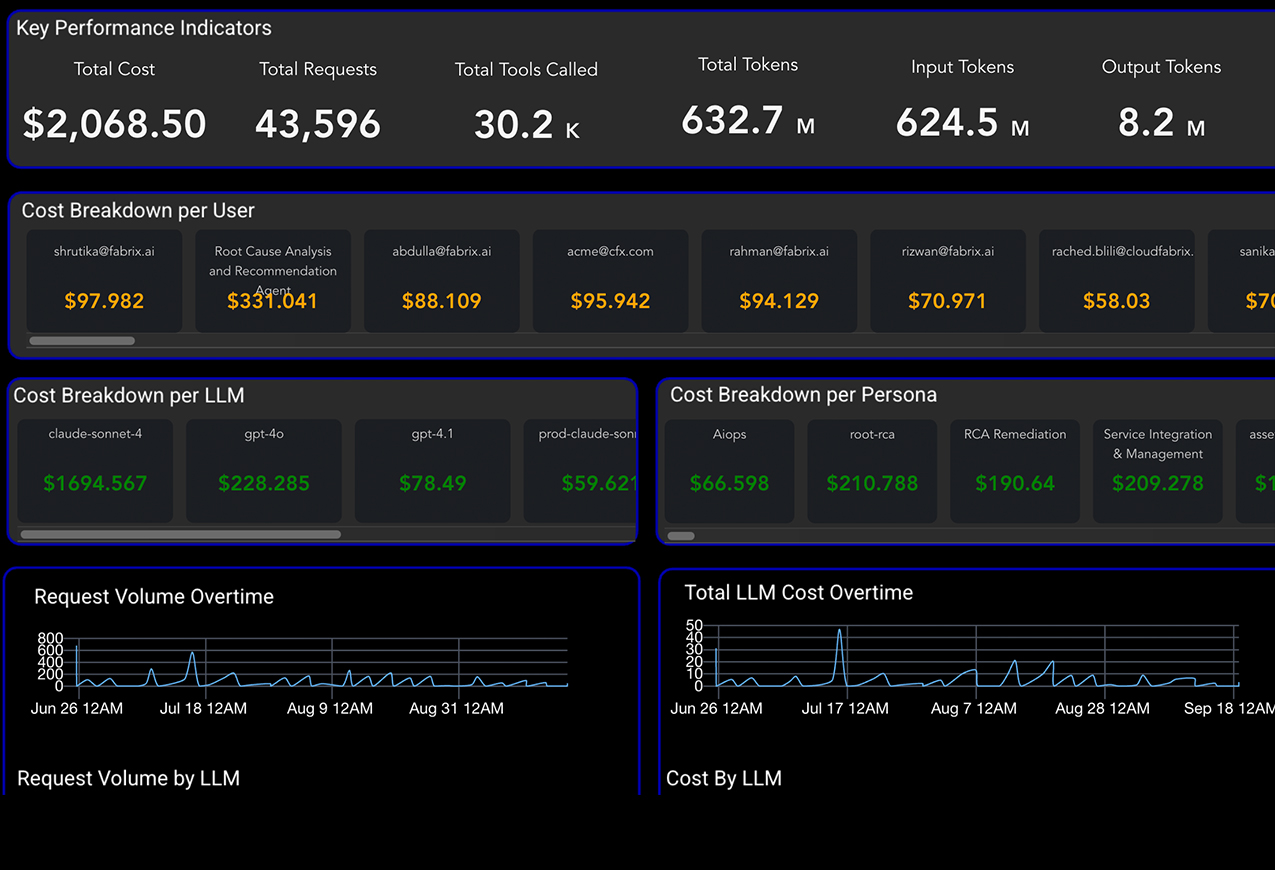
Know exactly where every dollar and token goes. Slice by model, team, user, persona, or agent - then drill into any run to understand what drove the cost.
- KPI tiles: cost, requests, tools, tokens
- Cost by LLM / user / persona / agent
- Trends: volume & cost over time
- Tokens: input vs. output, cache savings
- Mix: provider share, agent vs. copilot, tool domains
- Reliability: success rate, failed-run cost
- Drilldowns: user & agent usage tables
- AI Projects mapped to departments, teams and workstreams
- Budgets, schedules and caps allocated per project
- Agents assigned to projects, spend attributed automatically
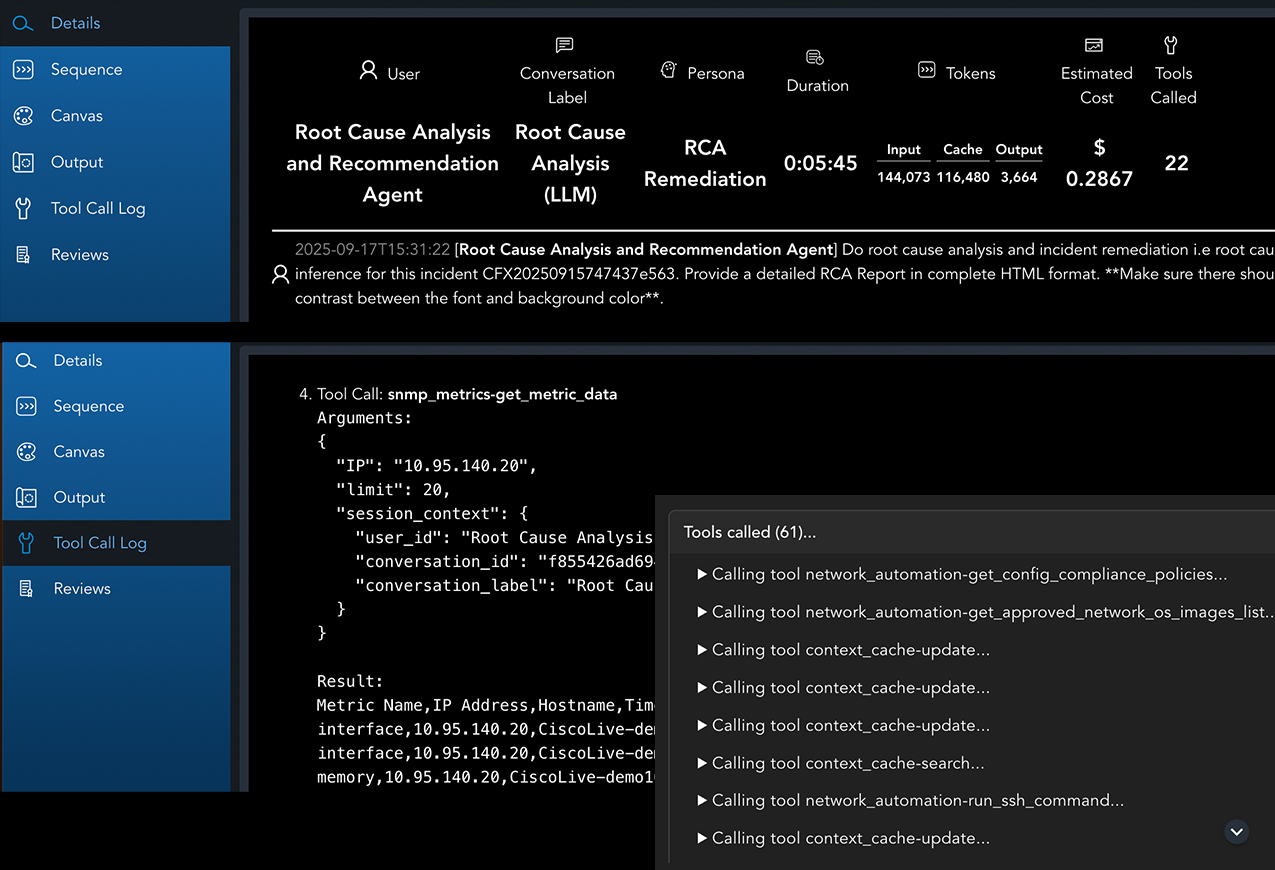
Make every AI decision transparent, auditable, and defensible. Every run includes a complete decision trace - reasoning chain, tool calls, evidence, and policy checks - so you can explain any outcome to any stakeholder.
- Chain of thought and full reasoning trace
- Tool call log with parameters and returned outputs
- Prompt & context snapshots - full LLM input/output view with redaction
- Run metadata: model, version, MCP tools, persona & scopes